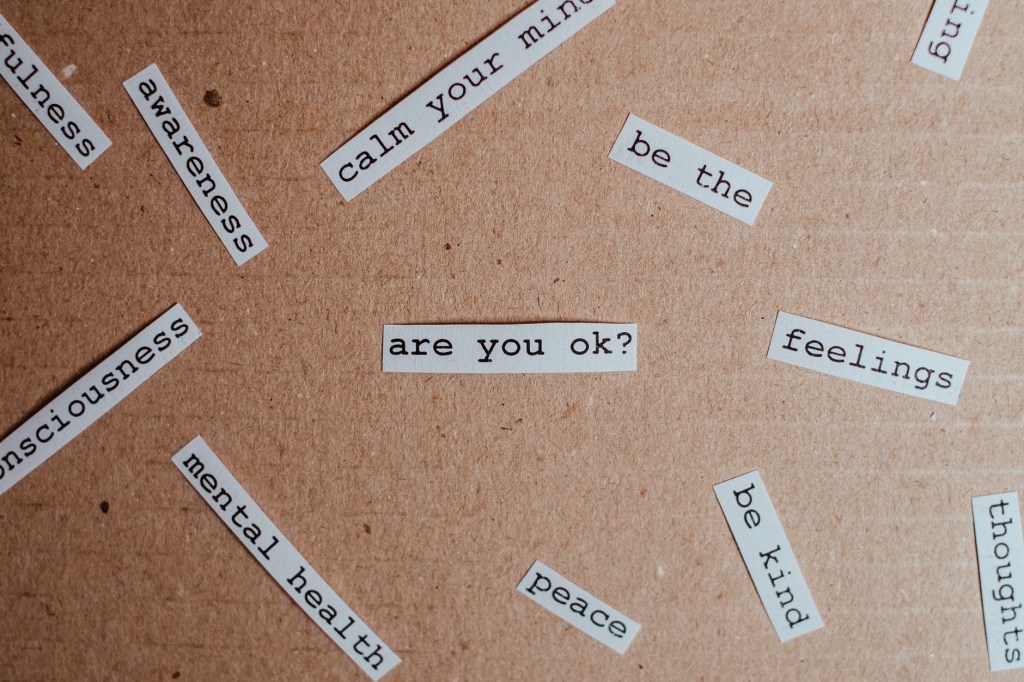
Mental health is a broad term that can mean a variety of things. Generally speaking, mental health focuses solely on someone’s well-being and mental illness focuses more specifically on actual disease processes.
Typically when we hear the term mental health we immediately begin thinking of specific mental health conditions such as anxiety, depression, OCD, schizophrenia, PTSD, eating disorders and more.
Although you may not have an actual mental illness, you do in fact have mental health. Everyone does. The World Health Organization states “ There is no health without mental health.” Our mental health is our ability to produce emotions, thoughts, and feelings. Every human on earth experiences this daily. You can have poor mental health without having an actual mental illness. Mental health issues often arise from a stress induced situation that is usually less severe and can be managed by situational changes. However, without addressing your mental state during difficult times; you are putting yourself at greater risk for developing a mental illness later down the road.
Mental health is important during every stage of life. From birth until death. Your mental well being effects how you think, feel, handle stress, and how you make choices/decisions.
Many factors take place when discussing the risks associated with mental illness. These factors can include but are not limited to: genetics, personal experiences, family history, and more.
Warning signs that you may be experiencing poor mental health or an actual mental illness would include:
⁃ low energy
⁃ Feeling numb
⁃ Feeling helpless or hopeless
⁃ Inability to perform daily tasks
⁃ Fighting with peers
⁃ Lack of food intake or over eating
⁃ Insomnia
⁃ Physical symptoms such as GI issues
Mental and physical health go hand in hand. It’s imperative that you take care of your mental state so that you don’t suffer physical conditions later on. It’s scientifically proven that mental illnesses can increase the risk for heart disease and stroke. The direct impact it has on eating and sleeping habits aren’t discussed enough.
Did you know that suicide is the second leading cause of death in America, amongst certain age populations? How heartbreaking is it to know that something that is 100% preventable, continues to take loved ones away from us, every single day? Guys, this really hits home for me. I lost my mom to a sudden battle with mental illness a little over a year ago.
If you didn’t know my mom, it may be difficult for me to find appropriate words that would describe her well enough. ( I may post a blog on this later). But for now I will say she was one of the most knowledgeable people I’ve ever encountered. She made a major impact to the healthcare field right here in our community. She was a phenomenal nurse for nearly 30 years. Full of life. Full of love. She had a strong support system and she lived her life to the absolute fullest. She was strong and independent. Unfortunately for unknown reasons, she was forced into a very dark place she couldn’t crawl out of. I can’t stress to you enough that mental health is important. Mental illness is raw & it’s real. It can effect anyone and it’s something that really needs to be addressed and taken seriously.
Mental illness does not discriminate. Read that again. MENTAL ILLNESS DOES NOT DISCRIMINATE. It doesn’t pick and chose your race, gender, or economical status. Your mental status can change abruptly due to unexpected life events that may be overwhelming. Extreme stress can effect your ability to cope and without healthy coping mechanisms it’s highly likely that your mental health will plummet quickly.
Contrary to popular belief, celebrities struggle everyday with mental illnesses. Who would think people of fame and fortune could have anything to stress over? Did you know that 1 in 5 Americans are diagnosed with a mental illness. Mood disorders are the most common cause of hospitalization in people under the age of 45, aside from childbirth. Among US adolescents 3 million had serious thoughts of suicide in 2020. The average delay between onset of mental health symptoms and treatment is 11 years. (National Alliance on Mental Illness). The statistics are there.
I know that life is hard. You should know that too. If not, I am genuinely thankful you’ve never had to experience hardships. But if you have, please know that you are not alone. I will give my undivided attention to you, to my family, friends, or a complete stranger in their time of need. Rest assured that it will be in the most non-judge mental way possible. Life is ugly sometimes and I truly understand that. We all have skeletons in our closet. There’s no reason to be embarrassed by them. By speaking out, you may determine your situation is more common than you realize.
Why do people struggle to reach out? It’s simple & it’s because of the stigma that is placed around mental illness. This usually comes from a lack of education. People fail to realize that sometimes mental illnesses arises due to factors that are beyond our control; such as chemical imbalances. Do you have a family member that’s a diabetic? Do they require insulin to control their blood sugars? What happens if their blood sugars are uncontrolled? Have you ever seen their mental status decline due to hypo or hyperglycemia? Low blood sugars can cause confusion while high blood sugars can cause extreme anger and sadness. To me that sounds almost like bipolar disorder and depression. Do you see where I’m going here…
(We) as a society really have to do better. If we make it our job to place judgement on other people, we are missing our opportunity to fulfill our own purposes. Our purpose in life is to find happiness in things that can motivate and influence our lives in positive ways. When we judge others we are ultimately allowing our brains to incorporate negative thoughts into our daily routines. By doing that, we aren’t giving ourselves the opportunity for personal growth. And that my friends, is NOT healthy.
One way to stop the stigma is by making ourselves better. It’s very simple to do. Here’s some tips:
⁃ Be a listening ear
⁃ Encourage others
⁃ Give factual and positive advice
⁃ Let them know they’re not alone
⁃ Tell them about available resources ( this will be discussed at a later time)
All in all, mental health is important for everyone. I will spend the rest of my life advocating for it in every way. Last but not least; Be sure you’re taking time for yourself. Self care is very important. We will discuss ways to promote self care a little later.
Thank you.
 Navigating Through Life
Leave a comment